

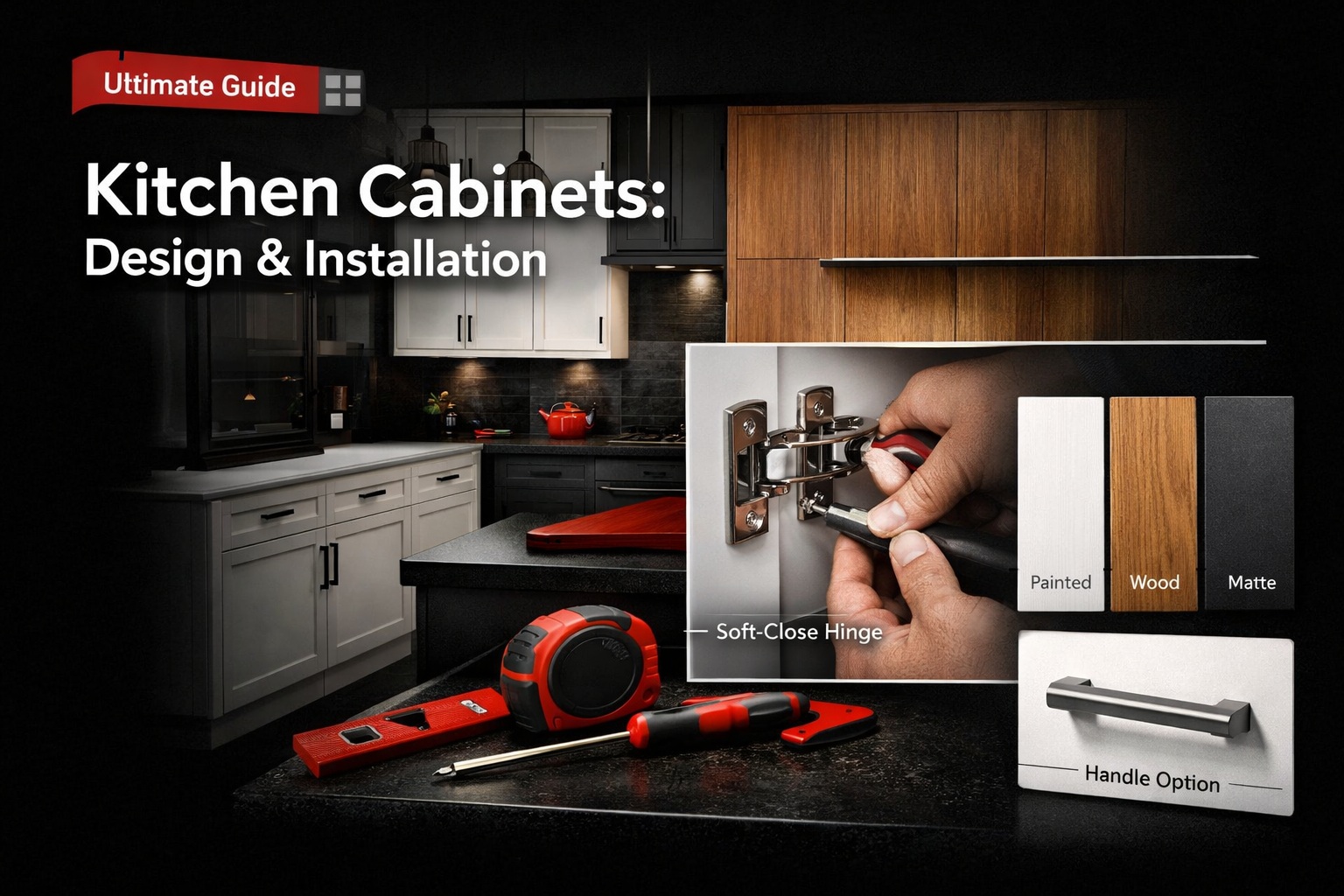
Here’s the thing about kitchen cabinets nobody tells you upfront: the difference between custom and modular isn’t just about money. It’s about how your kitchen actually gets built, how long you’ll wait, and whether you’ll get exactly what you want or learn to live with “close enough.”
I’ve watched people agonize over countertop materials for weeks while barely thinking about whether custom or modular cabinets make sense for their situation. That’s backwards. This decision affects everything else—your timeline, your budget, even which contractors you can work with.
So let’s break down what custom and modular actually mean, what you really get for your money with each option, and how to figure out which one makes sense for your specific kitchen. No sales pitch, just the real differences that matter.
Understanding the Basic Definitions
Let’s start with what we’re actually comparing because the terminology gets confusing.
What Are Custom Cabinets?
Custom cabinets are built specifically for your kitchen from scratch. A cabinet maker takes your measurements and builds boxes, doors, and drawers to your exact specifications. Any size, any configuration, any wood species, any finish—it’s all on the table.
Want a 37.5-inch wide cabinet because that’s what fits your wall perfectly? Done. Need a 96-inch tall pantry with specific shelf spacing for your collection of weird-sized serving platters? No problem. Want to match the exact grain pattern of your grandmother’s antique hutch? Custom can do that.
The builder creates shop drawings based on your kitchen layout, you approve them, and they build everything piece by piece in their workshop. Then they deliver and install cabinets made specifically for your space.
What Are Modular Cabinets?
Modular cabinets (also called semi-custom) come from manufacturers who produce cabinet boxes in standard sizes. Think 12-inch, 15-inch, 18-inch, 24-inch, 30-inch, 36-inch widths for base cabinets. Similar standardization for wall cabinets and tall cabinets.
But here’s the key: you get tons of options within that standardized framework. Different door styles, dozens of finish colors, various drawer configurations, storage solutions, and organizational accessories. You’re selecting from a catalog rather than designing from a blank slate.
Most quality modular cabinet lines offer enough size increments and filler pieces that you can fit almost any kitchen layout. You won’t get that weird 37.5-inch cabinet, but you’ll get a 36-inch cabinet with a 1.5-inch filler strip that accomplishes the same thing.
What About Stock Cabinets?
Quick note: stock cabinets are a third category—pre-built boxes sitting in a warehouse ready to ship immediately. Very limited sizes, styles, and finishes. We’re not covering stock cabinets in depth here because they’re a different decision entirely, usually driven by extreme budget constraints or rental property situations.
This comparison focuses on custom versus modular because those are the two choices most homeowners face when doing a serious kitchen.
The Cost Reality Check
Let’s talk money because this is usually the first question.
Custom Cabinet Pricing
Custom cabinets typically run $500-$1,200+ per linear foot installed, depending on wood species, finish complexity, and your local market.
For an average 10×12 kitchen with 25-30 linear feet of cabinets, you’re looking at $15,000-$35,000 just for cabinetry. High-end custom work in expensive markets? Easily $50,000-$80,000+.
What drives custom prices up:
- Labor: Hand-building everything takes time. Cabinet makers charge for their expertise and craftsmanship.
- Materials: You’re often choosing premium wood species, not builder-grade options.
- Customization: Every non-standard feature adds labor and complexity.
- Finishing: High-quality finishes—especially hand-rubbed stains or specialty paints—require multiple steps and skilled application.
Modular Cabinet Pricing
Modular cabinets run $200-$650 per linear foot installed for quality lines. The same 10×12 kitchen might cost $6,000-$18,000.
Yes, there’s overlap between high-end modular and entry-level custom. The lines blur in the $400-$600/linear foot range where both options exist.
Budget modular lines (think big box stores) can go lower—$150-$300/linear foot—but quality drops noticeably. You’re getting particleboard boxes and basic finishes at those price points.
The Real Cost Comparison
Let’s be honest: custom costs more. Usually 30-60% more than comparable-quality modular for a similar look.
But “comparable quality” is the key phrase. A $25,000 custom kitchen and a $25,000 modular kitchen aren’t necessarily equal. The custom kitchen might use superior joinery, better wood, more durable finishes. Or it might just be paying for the labor of building non-standard sizes you didn’t actually need.
Quality Differences That Actually Matter
Here’s where it gets interesting because quality isn’t automatically better with custom.
Construction Methods
Both custom and quality modular cabinets can use plywood boxes, dovetail drawer joints, and solid wood face frames. Construction quality depends more on the specific manufacturer or cabinet maker than whether it’s custom or modular.
I’ve seen custom cabinets with sloppy joinery and modular cabinets built like tanks. Brand and builder reputation matter more than category.
That said, custom builders often have more control over every detail. If you find a meticulous craftsperson, that attention to detail shows in the final product.
Material Options
Custom gives you unlimited wood species options. Want white oak boxes with walnut accents and cherry drawer fronts? Weird, but you can do it.
Modular manufacturers offer maybe 5-12 wood species depending on the line. Still plenty of choice for most people, but you can’t special-order exotic woods.
For painted cabinets, the difference matters less. Both custom and modular can deliver beautifully painted finishes.
Finish Durability
Factory-applied finishes on modular cabinets are often more durable than site-applied or small-shop finishes. Large manufacturers use catalyzed conversion varnish in controlled environments with UV curing. It’s tough stuff that stands up to kitchen abuse.
Custom cabinet finishes vary widely. Some shops have spray booths and use professional-grade finishes. Others hand-brush lacquer in dusty workshops. Ask about the finishing process specifically.
Long-Term Durability
Here’s a truth people don’t want to hear: both custom and modular cabinets from quality sources last 20-30+ years with proper care. The difference in longevity is marginal.
What matters more is how they’re installed, how you maintain them, and whether you picked quality hardware (hinges, drawer slides, etc.) regardless of custom or modular.
Timeline Considerations
When do you actually need your cabinets? This might be your deciding factor.
Custom Cabinet Timeline
Custom cabinets take time. Lots of time.
Design and approval: 2-4 weeks to finalize measurements, select materials, approve shop drawings.
Build time: 6-12 weeks for actual construction, depending on shop capacity and project complexity.
Finishing: 2-4 weeks for staining, painting, or other finish work.
Total: 10-20 weeks from order to installation. Longer if you change your mind mid-process or if the shop is backlogged.
This timeline affects your entire kitchen remodel. Can you live without a kitchen for 4-5 months? Do you have the budget for temporary cooking setups?
Modular Cabinet Timeline
Modular cabinets are faster. Much faster.
Design and ordering: 1-2 weeks to finalize selections and place order.
Manufacturing: 4-8 weeks depending on the manufacturer and time of year.
Total: 5-10 weeks from order to delivery.
For a complete kitchen renovation project, this timeline difference is huge. It might mean moving back into your kitchen a full two months earlier.
Rush Situations
Need cabinets quickly due to unexpected circumstances—water damage, failed inspection, whatever?
Modular is your only realistic option. Some manufacturers can expedite orders for rush fees. Custom builders can’t magically build faster.
Design Flexibility: Where Custom Shines
This is custom cabinets’ biggest strength. If your kitchen is weird, custom solves problems modular can’t.
Non-Standard Spaces
Got a kitchen with walls that aren’t square? Odd angles from an addition? Ceiling height that doesn’t match standard cabinet sizes? Existing soffits or bulkheads you’re working around?
Custom builders measure, adapt, and build to fit. They’re not constrained by standard box sizes.
Modular requires more creativity—using filler strips, scribing pieces, and strategic planning to make standard sizes work. It’s doable for most spaces, but truly irregular kitchens fight against modular systems.
Unique Design Elements
Want something architecturally specific? Maybe decorative corbels carved to match your home’s existing millwork? Cabinet feet designed to match your furniture style? Integrated appliance panels with custom venting?
Custom builders can execute these details. Modular manufacturers offer some decorative options, but you’re limited to what’s in the catalog.
Specialty Storage
Both custom and modular offer pull-out trash bins, spice racks, lazy Susans, and standard organizational features.
But if you need something truly specific—like a custom knife drawer with slots for your exact collection, or a pull-out cutting board at a non-standard height for accessibility reasons—custom gives you that flexibility.
Most people overestimate how much they need this flexibility, honestly. Standard modular storage solutions handle 90% of typical kitchen needs just fine.
When Modular Actually Makes More Sense
Let’s flip this. When should you choose modular over custom?
Budget-Conscious Projects
If your total kitchen budget is $30,000-$50,000, spending half of it on custom cabinets doesn’t leave enough for countertops, appliances, flooring, and labor. Modular cabinets let you allocate budget more effectively across the entire project.
Quality modular cabinets paired with beautiful countertop materials often create better overall kitchens than expensive custom cabinets with budget countertops and cheap appliances.
Standard Kitchen Layouts
If your kitchen has normal dimensions, standard ceiling heights, and square walls, modular cabinets fit perfectly. You’re not gaining anything with custom except longer wait times and higher costs.
A 10×12 galley kitchen? Modular handles it beautifully. An L-shaped layout with standard appliance spacing? Modular works great.
Resale-Focused Remodels
Planning to sell in 2-5 years? Modular makes more financial sense.
Buyers don’t pay dramatically more for custom cabinets versus quality modular cabinets. They notice style, condition, and layout—not whether your cabinets came from a catalog or a custom shop.
Spend your money on things buyers actually care about: updated appliances, nice countertops, good flooring, fresh paint.
Rental Properties
Obviously modular. Don’t overthink this. Durable, good-looking, cost-effective cabinets from a modular manufacturer check all the boxes. Custom is wasted on rental properties.
When Custom Makes Sense Despite the Cost
Now, when should you actually spend the extra money on custom?
Unusual Kitchen Layouts
If your kitchen was carved out of a weird space—maybe a converted garage or room addition—custom cabinets might be necessary, not optional.
Angled walls, sloped ceilings, non-standard door and window placements—these all fight against modular systems.
Forever Homes with Specific Needs
If you’re building your forever home and have specific requirements that matter to you—maybe accessible design features, specific storage for hobbies, or architectural details that match the rest of your historically accurate restoration—custom delivers what modular can’t.
Very High-End Markets
In luxury home markets where kitchen budgets easily exceed $100,000, the percentage difference between custom and modular matters less. At that level, you’re often choosing custom because you can, and because the entire home is built with that level of detail.
Matching Existing Cabinetry
If you’re adding onto a kitchen with existing custom cabinets you love, getting new custom pieces that match is often easier than finding modular equivalents.
The Hybrid Approach
Here’s a secret: you don’t have to choose exclusively one or the other.
Many smart kitchen designs mix custom and modular. Use modular for the bulk of standard-sized cabinets and custom for problem-solving pieces.
For example:
- Modular for all base and wall cabinets
- Custom for a specific pantry unit that fills an awkward nook
- Modular for perimeter cabinets
- Custom for a unique island with architectural details
This approach saves money while still solving layout challenges that modular can’t handle alone.
Making Your Decision: A Practical Framework
Stop reading reviews and Pinterest boards for a minute. Here’s how to actually decide:
Step 1: Measure and Assess Your Space
Get accurate measurements. Not just overall dimensions but also:
- Are walls plumb and square?
- Is the ceiling level?
- Where are existing plumbing, electrical, and gas lines?
- What are the actual dimensions, not the assumed standard sizes?
If everything measures within a quarter-inch of standard dimensions and walls are square, modular works. If you’re finding weird angles and non-standard heights, custom might be necessary.
Step 2: Define Your Budget Realistically
Not what you wish you could spend. What you actually have available for the entire kitchen remodel.
If cabinets would consume more than 40% of your total budget with custom, you’re probably better off going modular and upgrading other elements.
Step 3: Clarify Your Timeline
When do you need the kitchen functional? Work backwards from that deadline.
If you’re on a tight timeline, modular saves 6-12 weeks. That might be the deciding factor if you’re coordinating contractors or dealing with a hard deadline.
Step 4: List Your Must-Haves
What specific features do you absolutely need that standard options might not provide?
Most people discover their list is shorter than they thought. “I want custom cabinets” is different from “I need these three specific non-standard features that only custom can deliver.”
Step 5: Talk to Both Custom and Modular Providers
Get quotes from both. Seriously. Don’t assume you know which is better until you’ve priced both options for your specific kitchen.
You might discover that custom isn’t as expensive as you feared, or that modular offers more flexibility than you expected. Professional kitchen cabinet specialists can show you options you didn’t know existed.
Questions to Ask Cabinet Providers
Whether you’re talking to custom builders or modular dealers, ask these questions:
What’s the box construction? Plywood or particleboard? How thick are the sides?
What wood species and finishes are available? Can you see actual samples, not just photos?
What’s the warranty? How long? What does it cover?
What’s included in installation? Are you just getting boxes, or does the price include installation, crown molding, hardware?
How do you handle changes? What if measurements were wrong or something needs adjustment during installation?
Can I see completed projects? Photos are nice, but seeing actual installed kitchens is better.
What’s the realistic timeline from order to installation? Get specifics, not vague estimates.
Beyond Just Cabinets
Remember, cabinets are part of a larger system. They interact with everything else in your kitchen.
Your kitchen flooring choice affects cabinet installation—do cabinets sit on top of flooring or does flooring go around them? Different answers for custom versus modular projects sometimes.
If you’re updating bathroom cabinets simultaneously, consistency in style and finish between rooms matters. Modular lines sometimes offer coordinating bathroom vanities. Custom builders can match across rooms easily.
The complete design and installation process should consider how all elements work together, not just optimize cabinets in isolation.
The Real Bottom Line
Here’s what I’ve learned watching people make this decision:
Custom cabinets are fantastic when you need them. They solve problems modular can’t. They deliver exactly what you envision. But most kitchens don’t actually need custom to be beautiful, functional, and long-lasting.
Modular cabinets from quality manufacturers deliver 95% of what custom provides at 60-70% of the cost in 50% of the time. For most people, that’s the better choice.
The people happiest with custom are those who had specific reasons for choosing it—unusual spaces, matching existing work, or particular features they couldn’t get otherwise.
The people happiest with modular are those who made smart selections, worked with designers who knew the product lines well, and didn’t try to force their kitchen into configurations that fought against standard sizing.
Both can create kitchens you love living in for decades. The “best” choice isn’t universal—it’s whatever aligns with your specific space, budget, timeline, and actual needs rather than imagined ones.
Start by being honest about what you really need versus what sounds cool. Most of the time, that honesty points toward modular. Sometimes it reveals that custom is genuinely the right answer. Either way, you’ll make a better decision than just defaulting to whichever sounds more impressive.
And if you’re still genuinely unsure after all this? Talk to experienced kitchen design professionals who work with both custom and modular regularly. They’ll tell you what actually makes sense for your specific kitchen—not what makes them the most money, but what delivers the best result for your situation.
That’s worth more than any article can provide.
Leave a Reply