

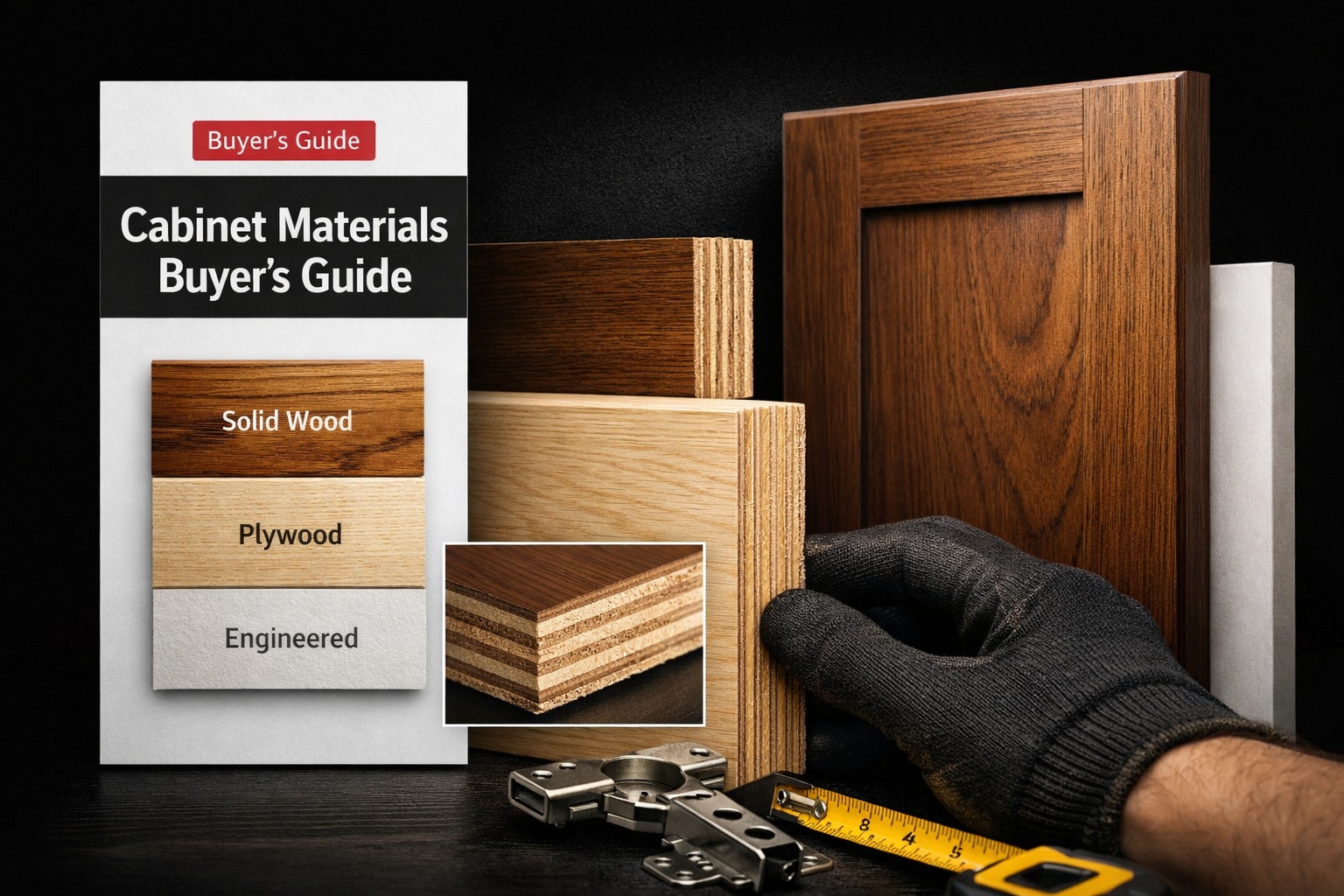
Walk into a cabinet showroom and ask what the cabinets are made of. You’ll get answers like “all-wood construction” or “premium materials” that sound impressive but tell you basically nothing.
Here’s what they don’t say upfront: “wood” cabinets aren’t all created equal. The difference between solid hardwood, furniture-grade plywood, MDF, and particleboard is enormous—in quality, durability, and price. And the confusing part? They can all technically be called “wood” cabinets.
I’ve seen people spend $20,000 on cabinets thinking they’re getting solid wood throughout, only to discover their boxes are particleboard that starts sagging within five years. I’ve also seen people overpay for solid wood in applications where high-quality plywood would’ve been smarter.
This guide breaks down every cabinet material option—what it actually is, what it costs, where it makes sense, and where it’s a waste of money. We’ll cover box construction, door materials, and how different materials hold up long-term.
By the end, you’ll know exactly what questions to ask and what to look for so you don’t get sold inferior materials at premium prices.
Understanding Cabinet Construction Basics
Before diving into specific materials, let’s clarify what parts of cabinets we’re talking about.
Cabinet Boxes (The Structure)
This is the sides, top, bottom, and back of the cabinet—the structural box that everything else attaches to. Box material determines long-term durability more than anything else.
Most people focus on door style and finish while ignoring box construction. That’s backwards. Beautiful doors on weak boxes means cabinets that fail prematurely.
Cabinet Doors and Drawer Fronts
These are what you see and touch daily. They can be made from different materials than the boxes. In fact, they often are.
Door material affects appearance and how well finishes hold up, but it doesn’t affect structural integrity much since doors aren’t load-bearing.
Shelves and Internal Components
Often overlooked but important for functionality. Weak shelving material sags over time, especially with heavy items like dishes or canned goods.
Now let’s get into the actual materials.
Solid Wood: The Premium Option
When people say they want “real wood” cabinets, this is usually what they mean.
What Solid Wood Actually Means
Solid wood is lumber cut from trees and milled into boards. No glue, no composite layers—just wood. Common species for cabinets include maple, cherry, oak, walnut, hickory, and birch.
Each species has different grain patterns, hardness, and color. Maple is smooth and takes paint well. Oak has prominent grain. Cherry darkens beautifully over time. Walnut is rich and expensive.
Where Solid Wood Makes Sense
Door frames and face frames: This is where solid wood really shines. The natural grain and depth looks beautiful, especially with stained finishes. The wood can be shaped, routed, and detailed in ways composite materials can’t.
Exposed components: Anywhere you’ll see the actual wood—face frames, decorative trim, furniture-style feet—solid wood is worth it for aesthetics.
Custom details: Turned posts, carved elements, intricate moldings—these need solid wood to work properly.
Where Solid Wood Doesn’t Make Sense
Cabinet boxes: Here’s a controversial take—solid wood boxes aren’t necessarily better than plywood boxes. Solid wood moves with humidity. It expands and contracts. Over time, this can cause joints to weaken.
Plywood is more dimensionally stable. For box construction, quality plywood often outperforms solid wood in longevity.
Solid Wood Costs
Expect to pay premium prices. Solid wood doors add 30-60% to cabinet costs compared to engineered alternatives. Material cost varies by species:
- Maple, birch: Moderate (most common)
- Oak: Moderate to high (depends on grade)
- Cherry, walnut: High (premium hardwoods)
- Hickory: High (dense and dramatic grain)
Solid Wood Maintenance
Wood needs care. It responds to humidity—expanding when humid, contracting when dry. This is normal, not a defect.
Don’t place cabinets near heat sources or in areas with extreme humidity swings. Clean with mild soap and water, not harsh chemicals that damage finishes.
Plywood: The Professional’s Choice
If I’m building cabinets for myself, I’m using plywood boxes. Here’s why.
What Plywood Actually Is
Plywood is thin wood veneers glued together in alternating grain directions. This cross-grain construction creates stability that solid wood can’t match.
Not all plywood is equal. There’s construction-grade plywood (what you use for roofing) and furniture-grade plywood (what belongs in cabinets). They’re completely different products.
Furniture-Grade vs Construction-Grade
Furniture-grade plywood: Smooth faces with minimal voids, consistent thickness, high-quality veneer on faces. This is cabinet-worthy material. Usually labeled as “cabinet-grade” or “furniture-grade.”
Construction-grade: Rougher faces, potential voids in core layers, inconsistent thickness. Fine for house framing, not for cabinets.
Always specify furniture-grade. It costs more but it’s the right material for the job.
Why Plywood Excels for Box Construction
Dimensional stability: Doesn’t expand and contract like solid wood. Maintains shape over decades.
Screw-holding power: Holds screws better than particle board or MDF. Hinges and drawer slides stay secure over thousands of open/close cycles.
Moisture resistance: While not waterproof, plywood handles occasional moisture exposure far better than particleboard. Important in kitchens and bathrooms.
Strength-to-weight ratio: Strong enough for structural use without being overly heavy.
Plywood Cabinet Costs
More expensive than particleboard, less expensive than solid wood throughout. For boxes, budget about 20-40% more than particleboard construction.
For a typical 10×12 kitchen, upgrading from particleboard to plywood boxes might add $1,500-$3,000 to the total. Worth it for the longevity.
What to Specify
When shopping for quality cabinets in your area, ask specifically:
“Are the cabinet boxes made from furniture-grade plywood or particleboard?”
If they say “wood,” ask again. “Plywood or solid wood?” Get specifics.
“What thickness is the plywood?” Standard is 1/2″ for sides/backs, 3/4″ for bottoms. Thicker is better for heavy-use cabinets.
MDF (Medium-Density Fiberboard): The Painter’s Friend
MDF has gotten a bad rap, but it’s actually excellent for certain applications.
What MDF Is
Wood fibers mixed with resin and compressed under heat and pressure. Creates a dense, smooth, consistent material with no grain.
It’s not pretending to be wood—it’s an engineered material with its own characteristics.
Where MDF Excels
Painted cabinet doors: This is MDF’s sweet spot. The smooth surface takes paint beautifully. No grain means no grain telegraphing through the finish. Paint on MDF looks better than paint on solid wood. Period.
High-end painted cabinets often use MDF doors specifically because the finish quality is superior.
Decorative moldings and trim: MDF can be routed and shaped cleanly. For painted trim pieces, it’s often better than solid wood because there’s no grain to worry about.
Stable substrates: MDF doesn’t expand and contract with humidity like solid wood. For painted applications, this stability means finishes last longer without cracking.
Where MDF Doesn’t Work
Anywhere with moisture exposure: MDF swells when wet and doesn’t recover. Never use MDF for bathroom vanity boxes or anywhere that might get soaked.
Load-bearing applications: MDF is heavy but not particularly strong. Poor choice for cabinet boxes or shelves that’ll bear significant weight.
Anywhere screws go repeatedly: Screws in MDF don’t hold well. Hinges and drawer slides in MDF strip out over time. This is why you don’t want MDF cabinet boxes.
MDF Costs
Cheaper than solid wood, similar to or slightly more expensive than particleboard, depending on grade and source.
For painted doors, MDF is often the most cost-effective way to get a truly premium finish appearance.
The Moisture Issue
Can’t stress this enough: MDF and water don’t mix. A small leak near MDF cabinets? The material swells and stays swollen. It doesn’t dry out and return to original shape.
This is why building codes often prohibit MDF in areas prone to moisture. For bathroom cabinet applications, stick with plywood boxes even if you use MDF doors.
Particleboard: The Budget Option
Let’s be honest about what particleboard is and isn’t.
What Particleboard Actually Is
Wood chips, sawdust, and particles glued together and compressed. It’s basically the stuff left over from processing real wood, reconstituted into boards.
Particleboard exists on a quality spectrum. High-density particleboard is acceptable for some uses. Low-density particleboard is garbage.
Where Particleboard Might Be Okay
Closet or garage cabinets: Low-use applications where longevity isn’t critical. If you’re building utility storage on a tight budget, acceptable.
Temporary solutions: If you’re planning to replace cabinets in 5-7 years anyway, particleboard gets you there cheaply.
Very light-duty use: A small cabinet holding decorative items might survive with particleboard construction.
Where Particleboard Fails
Kitchen cabinet boxes: This is the big one. Budget cabinet lines use particleboard boxes because it’s cheap. But over time:
- Screws pull out as hinges are used repeatedly
- Shelves sag under the weight of dishes
- Any water exposure causes swelling and deterioration
- The material can’t be repaired—once damaged, you’re replacing
High-moisture areas: Particleboard near sinks, dishwashers, or in bathrooms is a disaster waiting to happen. One leak and it’s done.
Heavy-use areas: Kitchen cabinets get opened and closed thousands of times. Particleboard doesn’t handle that stress well long-term.
The Reality of Budget Cabinets
Most big-box store cabinets under $150 per linear foot use particleboard boxes. They look fine initially. Three years in, you start noticing doors hanging unevenly. Five years in, shelves are bowing. Seven years in, you’re replacing them.
If your budget demands particleboard, fine—but go in with eyes open about the lifespan.
Particleboard Costs
Cheapest option for cabinet boxes. This is why budget manufacturers use it. Saves them money, makes cabinets “affordable,” but you pay later in replacement costs.
Combination Constructions: What Actually Makes Sense
Smart cabinet design uses different materials where each excels.
The Premium Combination
Plywood boxes: Durable, stable, moisture-resistant. The foundation that lasts decades.
Solid wood face frames and doors (if stained): Beautiful natural grain and color depth you can’t get otherwise.
MDF doors (if painted): Superior paint finish quality compared to solid wood.
This gives you durability where it matters and aesthetics where you see them. It’s what quality cabinet makers have done for years.
The Budget-Conscious Combination
Plywood boxes: Don’t compromise here. This determines longevity.
MDF doors: For painted cabinets, gets you great appearance at lower cost than solid wood.
Particleboard shelving (with edge banding): Okay for adjustable interior shelves if weight load is light. Fixed shelves should be plywood.
This prioritizes durability in structural components while saving money on cosmetic elements.
What Doesn’t Make Sense
Solid wood boxes with particleboard doors: Backwards. You’re spending on structure you don’t need while cheaping out on what you see daily.
MDF boxes with solid wood doors: The boxes will fail before the doors wear out. Waste of money on expensive doors.
Veneer vs Solid Wood for Doors
Another confusing topic that deserves clarification.
What Veneer Actually Is
Thin slices of real wood glued to a stable substrate (usually MDF or plywood). The face is real hardwood—just thin.
When Veneer Makes Sense
Stained flat-panel doors: Veneer over MDF or plywood creates a stable door that won’t warp like solid wood can. The veneer provides the wood appearance; the substrate provides stability.
Large panels: Solid wood panels can cup or warp. Veneer on engineered substrate stays flat.
Consistency: Veneer can be book-matched and selected for consistent appearance across all doors. Solid wood has more natural variation.
When Solid Wood Is Better
Raised panel doors: The depth and detail of raised panels requires solid wood. Veneer can’t create the three-dimensional profiles.
Routed details: Edge routing and decorative details work better with solid wood thickness.
Repairs: Solid wood can be sanded and refinished more times than veneer.
Quality Veneer vs Cheap Veneer
Thick veneer (1/16″ or more) over quality substrate is a premium product. Paper-thin veneer over particleboard is junk. Ask about veneer thickness and substrate material.
Making Your Decision: What Should You Buy?
Let’s get practical with specific scenarios.
For Serious Home Cooks (Heavy Daily Use)
Boxes: Furniture-grade plywood, 3/4″ sides. Non-negotiable.
Doors: Solid wood if stained, high-quality MDF if painted.
Shelves: Plywood, especially near the stove and sink.
Budget: Plan $400-$800 per linear foot installed.
You’re using these cabinets daily for decades. Invest in durability.
For Average Homeowners (Normal Use)
Boxes: Furniture-grade plywood, 1/2″ sides (3/4″ bottoms).
Doors: Veneer over engineered substrate if stained, MDF if painted.
Shelves: Plywood for fixed shelves, particleboard okay for adjustable shelves with light loads.
Budget: Plan $250-$450 per linear foot installed.
Good quality that’ll last 20+ years without overspending.
For Budget-Conscious Buyers
Boxes: Plywood if at all possible. If forced to use particleboard, choose high-density and avoid moisture-prone areas.
Doors: MDF painted or veneer over engineered substrate.
Shelves: Particleboard is acceptable for most interior shelving.
Budget: Plan $150-$250 per linear foot installed.
Prioritize box quality over door upgrades. Beautiful doors on failing boxes is false economy.
For Rental Properties
Boxes: Plywood if budget allows. High-density particleboard as minimum.
Doors: Whatever’s cheapest that looks decent. Tenants won’t treat them carefully anyway.
Shelves: Particleboard is fine.
Budget: Plan $100-$200 per linear foot installed.
Durability matters, but this isn’t your forever home.
How to Evaluate Cabinet Materials
When shopping, do this:
Ask Direct Questions
“What are the cabinet boxes made from? I need specifics—plywood, particleboard, or solid wood?”
“If plywood, what thickness and grade?”
“If particleboard, what density rating?”
“What are the doors made from?”
Inspect Physical Samples
Don’t rely on photos. Look at actual cabinet samples.
Check box construction: Is it plywood with visible layers, or compressed particleboard?
Check weight: Plywood boxes feel sturdy. Particleboard boxes feel dense but less substantial.
Look at joinery: How are corners joined? Dowels, dado joints, or just staples?
Test hinge attachment: Press on hinges. Do they feel secure or do screws flex?
Read the Fine Print
Marketing materials say “wood cabinets” or “all-wood construction.” That’s meaningless.
Look for specifications that say:
- “Furniture-grade plywood box construction”
- “3/4-inch plywood sides and bottoms”
- “Solid hardwood face frames”
If specs are vague, that’s a red flag.
Compare Written Warranties
Quality manufacturers warrant their materials. If the warranty excludes water damage entirely or only covers one year, they don’t trust their own materials.
Look for warranties of 5+ years on box construction and finish. That indicates confidence in the materials.
The Long-Term Cost Perspective
Cheap cabinets aren’t cheap if you replace them in 7 years.
Particleboard Box Math
$150/linear foot × 30 linear feet = $4,500
Lasts 7-10 years = $450-$640 per year of use
Need replacement after 10 years = another $4,500+ (likely more with inflation)
Plywood Box Math
$250/linear foot × 30 linear feet = $7,500
Lasts 25-30 years = $250-$300 per year of use
Still functional after 25 years, likely just refinishing doors
The higher upfront cost is actually cheaper long-term.
Working with Professionals
Choosing the right kitchen design and installation partner means finding people who care about material quality, not just making a sale.
Good designers and cabinet suppliers educate you about materials. They explain trade-offs honestly. They show you samples and demonstrate quality differences.
Bad ones use confusing language, avoid specifics, and steer you toward whatever’s most profitable for them regardless of your needs.
When planning a complete home renovation or even expanding your space with an addition, the materials conversation applies to all cabinetry throughout—kitchens, bathrooms, laundry rooms, built-ins.
For those really diving deep into cabinet decisions, understanding the complete picture of design, materials, and installation helps you make informed choices. And knowing whether to go custom or modular affects your material options too.
The Final Word
Cabinet materials matter. A lot.
Solid wood isn’t automatically better. Plywood isn’t inferior. MDF has legitimate uses. Particleboard has its place (limited as it may be).
What matters is using the right material in the right application. Plywood boxes with appropriate doors (solid wood, MDF, or veneer depending on finish) creates cabinets that last decades.
Particleboard boxes with fancy doors creates cabinets that look good in the showroom and fail in 5-7 years.
Ask questions. Demand specifics. Don’t accept vague “wood construction” claims. Get it in writing.
Your cabinets are a major investment. Make sure you’re actually getting what you’re paying for.
Leave a Reply