

Walk into any cabinet showroom and they’ll tell you their cabinets are “high quality” and “built to last.” Then they show you pretty door styles and finishes while hoping you don’t ask what’s actually holding those drawers together.
Here’s the thing: door style is what you see. Construction quality is what determines whether your cabinets are still functioning perfectly in 20 years or falling apart in 7.
I’ve seen gorgeous cabinets with dovetailed drawers on quality slides that still operate smoothly after 25 years. I’ve also seen cheap cabinets where drawer fronts literally fall off after 3 years because they were stapled together with hope and optimism.
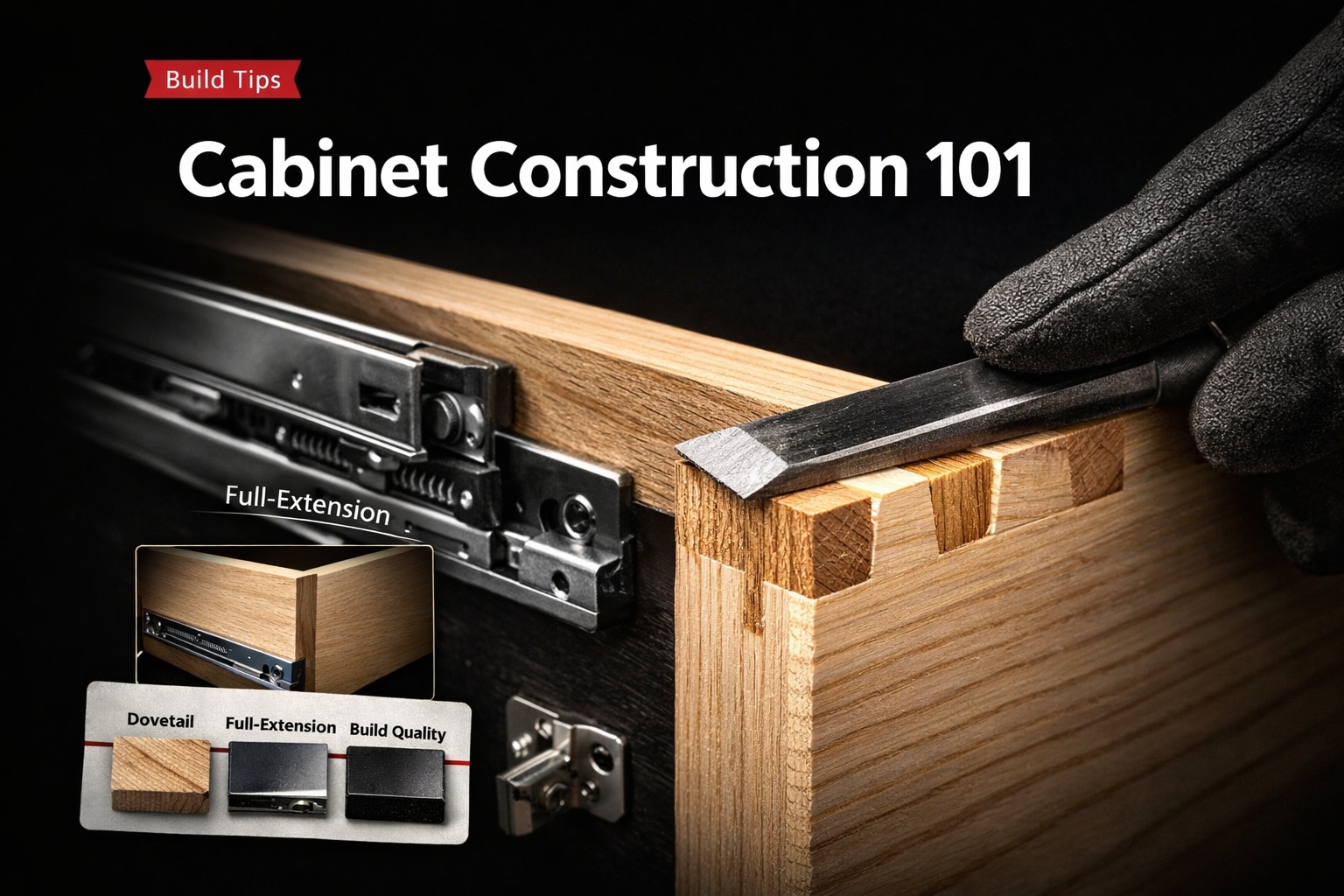
The difference comes down to joinery, hardware quality, and build techniques that most people never think to ask about. This guide breaks down exactly what separates quality construction from junk—dovetail joints versus stapled boxes, full-extension slides versus cheap roller tracks, and all the other details that matter.
By the end, you’ll know what questions to ask and what to look for so you don’t end up with cabinets that look great in the showroom but fail in real-world use.
Understanding Drawer Construction
Drawers get used constantly. Open and close cycles add up fast. Construction quality shows up here first.
Dovetail Joints: The Gold Standard
Dovetail joints are the interlocking teeth you see at drawer corners. Trapezoidal pins on one piece fit into matching slots on another piece.
Why dovetails matter: The joint is mechanically locked. Even without glue, dovetailed corners hold together through the interlocking shape. With glue, they’re incredibly strong. Pull forces actually tighten the joint rather than weakening it.
Types of dovetails:
Hand-cut dovetails: Artisan furniture makers cut these individually. Variable spacing, slightly irregular—signs of hand work. Beautiful but expensive and slow. Not common in production cabinets.
Machine-cut dovetails: CNC machines cut precise, consistent dovetails. Multiple pins and tails create extremely strong joints. This is what quality cabinet manufacturers use.
Half-blind dovetails: The joint is visible on drawer sides but hidden on the front. Creates clean appearance from front while maintaining dovetail strength. Common in furniture-quality drawer construction.
Through dovetails: Joint visible on both pieces. Sometimes used on drawer backs where visibility doesn’t matter.
Dowel Joints: The Middle Ground
Dowels are round wooden pins glued into holes drilled in both pieces being joined.
Quality dowel joints: Multiple dowels (typically 3-4 per corner), glued into precisely drilled holes. Creates strong connection when done properly. Faster and cheaper than dovetails but still decent.
Cheap dowel joints: Single dowel per corner or poorly aligned holes. Weak connection that fails under stress. Often breaks when drawers are overloaded or yanked hard.
Dado Joints
The drawer bottom sits in a groove (dado) cut into the drawer sides. Proper dado joints support the bottom across the entire perimeter rather than just nailing it to the bottom edge.
Why it matters: When you load a drawer with heavy items, forces distribute across the groove rather than concentrating on nails or staples. Drawer bottoms in dado grooves don’t sag or fall out.
Stapled or Nailed Construction: The Budget Approach
Pieces butted together and held with staples or nails. Maybe some glue if you’re lucky.
The problem: Staples and nails don’t create strong mechanical connections. They rely entirely on the holding power of metal in wood. Over time, with repeated stress, they pull out. Drawer fronts separate from sides. Bottoms fall out. It’s not if, it’s when.
Where you see this: Budget cabinets, builder-grade construction, stock cabinets at big-box stores priced aggressively.
What to Actually Specify
When buying cabinets, ask specifically: “Are drawer boxes dovetailed or what joinery is used?”
If they say “solid wood drawer boxes,” that’s not an answer. Wood type doesn’t tell you how it’s joined.
If they say “all-wood construction,” that’s also not an answer. Ask about the joinery method.
Get it in writing: “Drawer boxes feature dovetail joinery” or “Drawers constructed with dowel joints.” Specificity matters.
Drawer Slide Hardware: What Actually Works
The prettiest drawer box in the world is useless if it doesn’t open and close smoothly.
Full-Extension vs Partial-Extension Slides
Partial-extension slides: Drawer opens about 75% of the way. You can’t access the back of the drawer without pulling it all the way out (and risking it falling on the floor).
Full-extension slides: Drawer opens 100%, giving you complete access to everything inside. You can reach items at the very back without removing the drawer.
For kitchen cabinets, full-extension is essential. You need to reach pots at the back of the drawer, access items stored behind other items, see everything at once.
Partial-extension slides made sense decades ago when they were cheaper. Now the price difference is minimal and the functionality difference is enormous.
Undermount vs Side-Mount Slides
Side-mount slides: Attached to the sides of drawer boxes. Visible when drawer is open. Take up some interior width.
Advantages: Easier to install, easier to adjust, easier to replace if needed. Lower cost.
Disadvantages: Reduce usable drawer width slightly, visible hardware, can catch on items in drawer.
Undermount slides: Mounted underneath the drawer box. Hidden from view when drawer is open.
Advantages: Cleaner look, full interior drawer width available, don’t interfere with drawer contents.
Disadvantages: More complex installation, harder to adjust, more expensive, can be harder to replace.
For premium cabinets, undermount is standard. For budget cabinets, side-mount is common. Both work if quality slides are used.
Soft-Close Mechanism
Soft-close slides have dampening that catches the drawer in the last few inches of closing and gently pulls it shut. Prevents slamming.
Why it’s worth it: Reduces noise, prevents damage from slamming, extends hardware life, feels premium.
Cost difference: Minimal anymore. Soft-close used to be a luxury feature. Now it’s standard in mid-range and up cabinets. Maybe $5-10 more per drawer.
If you’re spending money on quality cabinets, soft-close is a no-brainer upgrade.
Weight Rating
Drawer slides have weight ratings—how much they can support when fully extended.
Light-duty (50-75 lbs): Adequate for small drawers with light items. Not enough for pot and pan drawers.
Medium-duty (75-100 lbs): Good for most kitchen drawers with normal loads.
Heavy-duty (100-150 lbs): Essential for large drawers storing cast iron cookware, small appliances, heavy dishes.
Extra heavy-duty (150+ lbs): Specialty applications, file drawers, really overloaded storage.
Match slide rating to actual use. Your pot drawer needs heavy-duty slides. Your utensil drawer can use medium-duty.
Brand Quality Matters
Blum: Industry standard. Excellent quality, smooth operation, long lifespan. Most premium cabinet makers use Blum.
Accuride: Another quality brand, especially popular for heavy-duty applications.
Hettich: European brand with excellent reputation. Quality comparable to Blum.
Generic/unbranded: Budget slides from unknown manufacturers. Work initially but often develop issues—sticking, misalignment, premature failure.
Spend the money on quality slides. They’re used dozens of times daily. Cheap slides are penny-wise and pound-foolish.
Door Hardware and Hinges
Doors open and close even more than drawers. Hardware quality is critical.
Hinge Types
European hinges (also called cup hinges or concealed hinges): Mount inside the cabinet, invisible when door is closed. Adjustable in three axes for perfect alignment. Standard in modern cabinets.
Face-frame hinges: Visible from outside when door is closed. Traditional look, still used in some styles. Less adjustable than European hinges.
Specialty hinges: Bi-fold, pocket door, flip-up—various specialty applications need specific hinge types.
Hinge Quality Indicators
Adjustment capability: Good hinges adjust in three directions (up/down, left/right, in/out). Allows perfect door alignment even if cabinet boxes aren’t perfectly square.
Soft-close dampening: Like drawer slides, soft-close door hinges catch doors before they slam. Extends hinge life, reduces noise, feels better to use.
Weight rating: Standard hinges handle normal doors. Heavy solid wood doors or doors with glass inserts need heavy-duty hinges.
Brand: Blum, Salice, Hettich, Grass—these are quality hinge manufacturers. Unbranded hinges from unknown sources are questionable.
How Many Hinges Per Door?
Standard doors (up to about 40 inches tall): Two hinges adequate.
Tall doors (40+ inches): Three hinges prevent sagging and ensure smooth operation.
Heavy doors: Extra hinges distribute weight better.
Skimping on hinges leads to sagging doors and alignment problems. Use appropriate number for door size and weight.
Testing Hinges
When evaluating cabinets, open and close doors repeatedly. They should move smoothly with no binding, squeaking, or catching. Soft-close should engage smoothly, not jerk to a stop.
If hinges feel rough or inconsistent in a showroom display, they’ll be worse after years of use in your home.
Box Construction and Joinery
The cabinet box itself—the structural frame everything else attaches to—determines long-term durability.
How Boxes Are Joined
Dado and rabbet joints: Sides fit into grooves cut in the top/bottom pieces. Creates mechanical lock reinforced with glue. Strong, professional construction.
Dowel joints: Similar to drawer construction. Multiple dowels glued into aligned holes. Done properly, creates strong connection.
Cam lock connectors: Metal hardware that locks pieces together. Common in flat-pack furniture and some modular cabinets. Strong if quality hardware is used, but creates visible holes.
Staples/nails: Budget approach. Not adequate for cabinet boxes that’ll support weight and years of use.
Face Frame Construction
Face frames (the front border on framed cabinets) should be joined with mortise and tenon joints, dowels, or pocket screws. Butt joints held with staples fail over time.
Quality face frames feel solid. Grab the frame and try to twist it. Cheap construction flexes. Quality construction is rigid.
Reinforcement
Look for corner blocks, gussets, or other reinforcement at stress points. These add material and labor cost but dramatically increase strength.
Cabinets without reinforcement rack and twist over time, leading to doors that won’t close properly and drawers that bind.
Back Panel Quality
Cabinet backs are often overlooked but they matter.
Full Back vs Partial Back
Full back panels: Cover the entire back of the cabinet. Provide maximum rigidity and prevent racking (cabinet twisting out of square).
Partial backs: Strips or panels that don’t cover the full back. Cheaper, less rigid. Cabinet can twist over time.
For wall cabinets especially, full backs are important. They’re what you’re screwing into the wall. Weak backs mean weak wall attachment.
Back Material
Plywood: Best choice. Rigid, strong, holds screws well.
Hardboard: Thin compressed wood fiber. Adequate for small cabinets, marginal for large ones.
Thin plywood or MDF: Better than hardboard, not as good as quality plywood.
Attachment Method
Backs should be set into dados (grooves) and glued, or securely fastened with multiple screws or staples.
Backs that are just tacked on with a few staples can pull loose over time.
Shelf Construction and Support
Shelves carry weight. How they’re built and supported matters.
Shelf Material and Thickness
3/4-inch plywood: Standard for quality cabinets. Won’t sag under normal loads even on 36-inch spans.
3/4-inch particleboard: Adequate for lighter loads, marginal for heavy items. Can sag over time, especially in wider cabinets.
1/2-inch anything: Too thin for most applications. Will sag with even moderate weight.
Shelf Support Methods
Dado mounting (fixed shelves): Shelf sits in grooves cut into cabinet sides. Very strong, distributes load across entire depth. Can’t adjust height.
Pin supports (adjustable shelves): Removable pins fit into holes drilled in cabinet sides. Shelf rests on pins. Allows height adjustment but less strong than dado mounting.
Clips: Similar to pins but with locking mechanism. Slightly more secure.
For fixed shelves (common at cabinet bottom or top), dado mounting is strongest. For adjustable shelves, quality pin supports work fine with appropriate shelf thickness.
Shelf Spans
Particleboard shelves: Keep spans under 30 inches to prevent sagging.
Plywood shelves: Can span 36 inches safely for most loads.
Heavy loads: Regardless of material, add center support for spans over 32 inches if shelf will carry heavy items.
Evaluating Overall Build Quality
How do you assess construction quality when shopping for cabinets?
Questions to Ask
“What joinery method do you use for drawer boxes?” (Answer should be dovetail or quality dowel joints)
“Are these full-extension soft-close drawer slides?” (Answer should be yes for quality cabinets)
“What brand of drawer slides and hinges?” (Look for Blum, Accuride, Hettich)
“What thickness are the cabinet sides and shelves?” (3/4-inch standard for quality)
“Are backs full or partial, and what material?” (Full plywood backs best)
“How are the face frames joined?” (Dowels or mortise and tenon, not just staples)
Physical Inspection
Open and close drawers: Should glide smoothly. Look for dovetail joints at corners. Check for dado groove holding bottom panel.
Test drawer slide extension: Pull drawer completely out. Full-extension slides should give you access to the entire drawer.
Examine hinges: Open and close doors. Look for three-way adjustment capability. Test soft-close dampening if present.
Check box rigidity: Try to twist or rack display cabinets. Quality construction resists twisting.
Inspect joinery: Look at corners, joints, connection points. Are they precisely aligned? Well-glued? Reinforced?
Weight assessment: Quality cabinets feel substantial. Lift a drawer box—solid plywood with dovetails feels different than particleboard with staples.
Compare Across Price Points
Look at budget, mid-range, and premium cabinets side by side. The construction differences become obvious when directly compared.
Budget cabinets feel lighter, flexier. Hardware operates roughly. Joinery is simpler.
Premium cabinets feel solid. Hardware is smooth and precise. Joinery is more sophisticated.
Mid-range cabinets fall somewhere between—decent construction without premium pricing.
Why Construction Quality Affects Long-Term Value
Yes, quality construction costs more. But over a 20-30 year cabinet lifespan, it’s absolutely worth it.
The Math of Durability
Budget cabinets ($150/linear foot): Last 7-10 years before needing replacement. $150 × 10 years = $15/year cost
Quality cabinets ($400/linear foot): Last 25-30 years with same functionality. $400 × 25 years = $16/year cost
The per-year cost is basically identical. But quality cabinets avoid the disruption, waste, and hassle of replacing cabinets after just 7 years.
Plus, quality cabinets maintain resale value. When you sell your home, buyers notice cabinet quality.
Repair and Replacement
Budget cabinets: When drawer slides fail or doors sag, often not worth repairing. The cabinet boxes themselves are marginal, so you’re just delaying inevitable replacement.
Quality cabinets: If a drawer slide fails (rare with quality hardware), you can replace just that component. The cabinet box is solid and worth maintaining.
Making Your Decision
What level of construction quality do you actually need?
For Rental Properties
Decent construction that’ll last through several tenant turnovers. Mid-range is probably appropriate. Overbuilding is wasted money.
For Starter Homes You’ll Sell Soon
If you’re planning to sell in 2-3 years, mid-range construction makes sense. Quality that shows well without premium pricing.
For Your Long-Term Home
Where you’ll live for 10+ years? Invest in quality construction. You’ll use these cabinets daily for decades. Dovetails, full-extension slides, quality hinges—all worth it.
For Forever Homes
If you’re never moving, get the best construction you can afford. This is your last kitchen. Build it to last your lifetime.
Working with Professionals
Understanding construction quality helps when working with kitchen specialists in your area. You can have informed conversations about what you’re actually getting.
Professional kitchen designers and installers know construction quality matters. They’ve seen what fails and what lasts. They can guide you toward appropriate quality for your needs and budget.
Whether you’re doing complete home renovation work or just focusing on the kitchen, cabinet construction quality affects your daily life for years. Worth getting right.
And if you’re also considering bathroom vanity upgrades, the same construction principles apply—dovetails, quality hardware, proper joinery matter everywhere.
For those deep-diving into cabinet decisions, understanding the complete picture from materials through installation helps make informed choices. And knowing whether custom or modular construction fits your needs affects which quality features are available to you.
The Bottom Line
Cabinet construction quality is mostly invisible—hidden inside drawer boxes, behind door hinges, in the thickness of materials and methods of joinery.
But that invisible quality determines whether your cabinets are still functioning beautifully in 20 years or falling apart in 7.
Dovetail drawers, full-extension soft-close slides, quality hinges, proper joinery, appropriate materials—these aren’t sexy selling points. They don’t show up in beautiful photos or inspire Pinterest boards.
But they’re what separates cabinets you love using for decades from cabinets you regret buying after a few years.
Ask the questions. Inspect the construction. Don’t accept vague claims of “quality” without specifics. Get it in writing.
Your future self—the one still enjoying smoothly operating drawers 20 years from now—will thank you.
Leave a Reply